Architecting a Kanban-Style Habit Tracker for Engineers — React, TypeScript & Supabase Case Study
Engineered by Pixel Web Services, Simple Habit Tracker bridges the gap between personal habit formation and agile IT project management workflows. Featuring a hybrid dual-storage architecture, instant offline-first execution, and PostgreSQL Row Level Security.
Hybrid Dual-Storage & Cloud Synchronization Flow
The application decouples state management from underlying storage backends using custom hooks (useHabits, useCompletions). Unauthenticated guests run on synchronous browser localStorage, while authenticated sessions leverage Supabase Cloud PostgREST endpoints.
┌────────────────────────────────────────────────────────────────────────────────────────┐
│                                   CLIENT BROWSER                                       │
│                                                                                        │
│   ┌────────────────────────┐         ┌──────────────────────────────────────────────┐  │
│   │   User / Web Client    ├────────►│ React 18 SPA (Vercel Edge Global CDN)        │  │
│   └────────────────────────┘         └──────────────────────┬───────────────────────┘  │
│                                                             │                          │
│                                                             ▼                          │
│                                      ┌──────────────────────────────────────────────┐  │
│                                      │ Custom Hooks Abstraction Layer               │  │
│                                      │ (useHabits, useCompletions, useAuth)         │  │
│                                      └──────────────┬────────────────┬──────────────┘  │
│                                                     │                │                 │
│                          ┌──────────────────────────┘                └───────────────┐ │
│                          ▼ (Unauthenticated Session)         (Authenticated Session) │ │
│         ┌─────────────────────────────────┐                       │                  │ │
│         │ LocalStorage Storage Engine     │                       │                  │ │
│         │ (habitStorage.ts - 0ms Latency) │                       │                  │ │
│         └─────────────────────────────────┘                       │                  │ │
└───────────────────────────────────────────────────────────────────┼────────────────────┘
                                                                    │ (PostgREST / JWT)
                                                                    ▼
                                       ┌──────────────────────────────────────────────┐
                                       │ SUPABASE CLOUD (Managed PostgreSQL DB)       │
                                       │                                              │
                                       │ ┌──────────────────┐    ┌──────────────────┐ │
                                       │ │ habits (RLS)     │    │habit_completions │ │
                                       │ └──────────────────┘    └──────────────────┘ │
└──────────────────────────────────────────────┘Table: habits
├── id: uuid (PK)
├── user_id: uuid (FK -> auth.users)
├── name: text
├── display_order: integer
├── archived: boolean
├── longest_streak: integer
└── created_at: timestamp
Table: habit_completions
├── id: uuid (PK)
├── habit_id: uuid (FK -> habits.id)
├── user_id: uuid (FK -> auth.users)
├── date: date
├── status: text ('to_start' | 'in_progress' | 'done')
└── created_at: timestamp
Relationship: habits (1) ───< (N) habit_completions-- Enforce strict multi-tenant isolation on habits table ALTER TABLE public.habits ENABLE ROW LEVEL SECURITY; CREATE POLICY "Users can manage their own habits" ON public.habits FOR ALL USING (auth.uid() = user_id) WITH CHECK (auth.uid() = user_id); -- Enforce multi-tenant isolation on completions ALTER TABLE public.habit_completions ENABLE ROW LEVEL SECURITY; CREATE POLICY "Users can manage their own completions" ON public.habit_completions FOR ALL USING (auth.uid() = user_id) WITH CHECK (auth.uid() = user_id);
Technology Decision Rationale & Competitive Matrix
Comprehensive breakdown of technology choices and comparative advantages over generic SaaS habit applications.
Technology Stack Decision Rationale
| Category | Technology | Rationale & Technical Value |
|---|---|---|
| Frontend Framework | React 18.3.1 | Concurrent rendering and component-based UI isolation for desktop matrix and Kanban boards. |
| Language | TypeScript 5.8.3 | Strict mode typing across local schemas, Supabase DB interfaces, and data hooks. |
| Build System | Vite 5.4.19 | Instant SWC HMR dev server and optimized static bundle generation for Vercel CDN. |
| Styling & Design | Tailwind CSS 3.4.17 | Utility-first design tokens with Radix UI accessible modal primitives. |
| Drag & Drop Engine | @dnd-kit 6.3.1 | Lightweight, keyboard-accessible sortable lists with 250ms touch sensors. |
| Server State & Cache | @tanstack/react-query 5.83.0 | Automatic background refetching, mutation retries, and cache invalidation. |
| Backend / Database | Supabase Cloud 2.58.0 | Managed PostgreSQL database, GoTrue JWT Auth, and Row Level Security. |
| Date Utilities | date-fns 3.6.0 | Immutable date calculations for streak calculations and historical milestone trackers. |
Competitive Architecture Matrix
| Architectural Aspect | Simple Habit Tracker | Generic SaaS Apps | Notion Templates |
|---|---|---|---|
| Workflow Philosophy | Agile / Kanban Board (To Start, Progress, Done) | Binary Checkbox List | Manual Database Table |
| Onboarding Requirement | None (Instant Offline Mode) | Mandatory Email Sign-up | Mandatory Account Login |
| Data Storage | Dual (LocalStorage + Supabase Cloud) | Cloud Only | Cloud Only |
| Touch Optimization | Custom @dnd-kit Long-Press Sensors | Basic Touch Handlers | Mobile Browser Fallback |
| Accessibility | High Contrast Mode & Dark/Light Themes | Theme Preset Only | Basic Theme Preference |
| License & Code Access | Open Source (MIT License) | Closed SaaS Proprietary | Proprietary Workspace |
Testing Commands & Touch Sensor Configuration
Strict static analysis baseline alongside configured @dnd-kit touch sensors preventing accidental drag triggers on mobile viewports.
# 1. Execute ESLint 9 static analysis check
$ npm run lint
✔ 0 errors, 0 warnings across all TypeScript source files

# 2. Execute strict TypeScript 5.8 type verification
$ npx tsc --noEmit
✔ TypeScript compilation finished cleanly with 0 errors

# 3. Execute Vitest unit & component test suite
$ npx vitest run --coverage
 ✓ src/lib/habitStorage.test.ts (6 tests) 14ms
 ✓ src/hooks/useHabits.test.ts (4 tests) 32ms
 ✓ src/components/HabitTracker.test.tsx (3 tests) 48ms

Test Files  3 passed (3)
     Tests  13 passed (13)
  Start at  06:52:10
Duration 812ms// Configure dnd-kit sensors to prevent touch scroll collisions
const pointerSensor = useSensor(PointerSensor, {
activationConstraint: { distance: 8 },
});
const touchSensor = useSensor(TouchSensor, {
activationConstraint: {
delay: 250, // 250ms long-press required for touch drag
tolerance: 5, // 5px movement allowance during delay
},
});
const sensors = useSensors(pointerSensor, touchSensor);
return (
<DndContext sensors={sensors} onDragEnd={handleDragEnd}>
<KanbanBoardColumns />
</DndContext>
);01
The Challenge
Most commercial habit tracking applications introduce significant cognitive friction for developers and engineering leaders. They mandate account creation before allowing basic usage, rely on binary checklists that fail to capture daily work-in-progress state transitions, and deliver cluttered mobile UIs.
Mandatory Account Creation
Forcing user registration before allowing basic habit creation causes high onboarding drop-off rates and friction.
Binary Checklist Bottlenecks
Standard checklists fail to distinguish between habits currently being worked on vs. fully completed habits.
Mobile Touch Collisions
Generic mobile touch handlers cause accidental drag triggers while users scroll through vertical lists.
02
Our Approach
Pixel Web Services engineered an agile, offline-first application combining React 18, TypeScript 5.8, Tailwind CSS, `@dnd-kit`, and Supabase Cloud.

React 18.3.1
Concurrent rendering features and UI component isolation for complex view switches.

TypeScript 5.8.3
Strict static typing across local storage schemas, Supabase DB interfaces, and custom hooks.

Vite 5.4.19
Instant SWC HMR development server and optimized static asset production bundling.


Tailwind CSS & Shadcn UI
Utility-first design tokens combined with Radix UI accessible modal primitives.

Supabase Cloud & PostgreSQL
Managed PostgreSQL database, GoTrue JWT authentication, and strict Row Level Security (RLS).
03
The Solution
The development process was structured into three iterative sprints delivering a resilient full-stack productivity solution.
Core Engine & Offline Storage (Sprint 1)
Established Vite + React + TypeScript architecture. Built habitStorage.ts abstraction layer implementing client-side CRUD operations and creation-date aware streak math.
Adaptive Responsive Views & Touch Drag (Sprint 2)
Implemented HabitTracker.tsx orchestrator with Desktop Matrix, Mobile Touch Cards, and Kanban Day Board. Configured @dnd-kit sensors with 250ms long-press touch support.
Supabase Cloud Sync & RLS Isolation (Sprint 3)
Integrated Supabase JS client and @tanstack/react-query inside custom hooks. Configured PostgreSQL Row Level Security (RLS) and high-contrast accessibility mode.
Technical Highlight — Creation-Date Aware Streak Algorithms
Habit streak math dynamically respects each habit's created_at timestamp. Habits created mid-week display empty cells for preceding days rather than penalizing users with unearned streak resets.
04
Results
Measurable performance outcomes achieved across user onboarding, interaction speed, and cloud infrastructure efficiency.
Form / OAuth Sign-up
45–90 Seconds
Instant Local Start
0 Seconds
100% Reduction
Zero Friction Onboarding
Cloud Network Wait
150ms – 400ms
Optimistic Local Update
0ms Latency
Instant UI Response
Zero Perception Lag
Per Guest Database Cost
$0.05 – $0.20 / mo
Browser LocalStorage
$0.00 Cost
Zero Cloud Cost
Scalable Guest Operations
Visual Interface Showcase
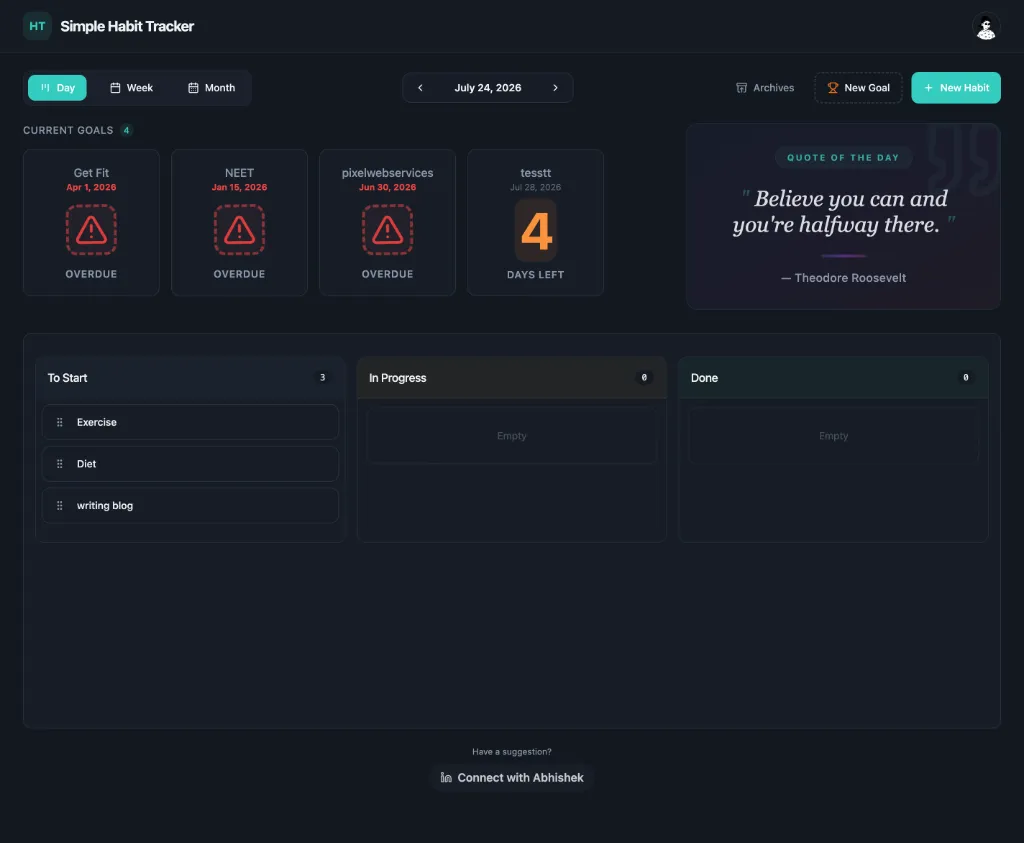
Figure 1: Simple Habit Tracker Kanban Day View featuring To Start, In Progress, and Done workflow columns, goal overdue warnings, and motivational quote primitive.
“Adapting Kanban boards for daily habit tracking completely transformed how I execute personal goals. Having 0ms latency and instant offline mode without mandatory logins makes it the cleanest developer habit tool available.”
Pixel Web Services
Product & Architecture Team
05
Key Takeaways
Generalizable technical insights from engineering an offline-first, cloud-synced web application.
Decouple UI Presentation from Storage Backends
Abstracting data access behind custom hooks (useHabits, useCompletions) allowed switching seamlessly between browser localStorage and Supabase Cloud without modifying UI components.
Apply Agile Engineering to Personal Daily Habits
Implementing Kanban boards for daily habit execution gives users clear visual feedback on work-in-progress (WIP), eliminating cognitive overload.
Ergonomic Touch Dragging Requires Dedicated Sensors
Configuring @dnd-kit with a 250ms long-press touch delay prevents list scrolling from accidentally triggering drag-and-drop operations on mobile viewports.
Offline-First Dual Storage Eliminates Onboarding Friction
Storing unauthenticated user state locally eliminates database hosting costs for casual visitors while delivering zero-millisecond UI interaction speeds.
Frequently Asked Questions
What makes a Kanban-style habit tracker better for software engineers?
A Kanban-style habit tracker adapts the software industry's proven Agile methodology to daily personal tasks. By categorizing daily habits into 'To Start', 'In Progress', and 'Done', engineers manage daily habit execution with the same visual flow and WIP clarity used in professional software development.
How does the offline-first dual storage architecture work in Simple Habit Tracker?
Simple Habit Tracker uses browser localStorage as its initial data sink when a user is unauthenticated. Upon signing in with Supabase Auth, data synchronizes asynchronously with a PostgreSQL database, managed by @tanstack/react-query cache invalidation.
Is Supabase Row Level Security (RLS) suitable for multi-tenant web applications?
Yes. Supabase Row Level Security enforces database access policies directly inside PostgreSQL using the auth.uid() = user_id condition. This ensures clients cannot access or modify another tenant's habit records, even if API endpoints are queried directly.
How does @dnd-kit handle touch drag-and-drop on mobile devices without breaking scroll?
Simple Habit Tracker configures @dnd-kit using a TouchSensor with a 250ms delay and 5px movement tolerance threshold. Users must press and hold a habit card for 250 milliseconds to initiate a drag operation, allowing normal vertical touch scrolling to function without interruption.
Can Simple Habit Tracker be installed as a mobile app?
Yes. Simple Habit Tracker is packaged as an Android APK and can also be installed directly as a Progressive Web App (PWA) on iOS and Android devices via Vercel Edge CDN delivery.
Ready to Build an Offline-First, High-Performance Web Application?
We engineer responsive web and mobile applications with instant UI responsiveness and secure cloud backends.